

✔ Backed by: American Heart Association · National Heart, Lung, and Blood Institute (NIH) · Heart Rhythm Society. Each fact links to its source, and the full list is at the bottom of this post.
If someone collapses and is not responding or not breathing normally, call 911 right now. It could be sudden cardiac arrest. Start CPR and send someone to find an AED. Do not wait to read this article.
October is Sudden Cardiac Arrest Awareness Month [1]. The Heart Rhythm Society uses the month to help people learn the warning signs, act quickly, and learn CPR and how to use an AED [1]. That last part is where you come in. You do not need to be a nurse, a doctor, or a lifeguard to help. Much of what matters happens in the first few minutes, often before an ambulance arrives.
This article explains what cardiac arrest is, how to spot it, and the two simple steps of hands-only CPR. It also covers AEDs and a few easy ways to get ready this month.
What sudden cardiac arrest is, and why minutes matter
Cardiac arrest happens when the heart suddenly and unexpectedly stops pumping. Blood stops reaching the brain and other vital organs [2]. The main cause is a dangerous heart rhythm problem, called an arrhythmia [2]. In the United States, cardiac arrest causes about 300,000 to 450,000 deaths each year [2].
Those numbers are hard to hear, but they explain why bystanders matter so much. The National Heart, Lung, and Blood Institute says nine out of 10 people who have a cardiac arrest outside a hospital die, often within minutes [2]. Help that starts right away, from the people nearby, can make a real difference.
Cardiac arrest can also strike people who seem healthy. NHLBI says half of cardiac arrests happen to people who did not know they had a heart problem [2]. So this is not only something for heart patients to learn. It is for everyone.
Heart attack and sudden cardiac arrest are not the same
People often mix these two up. The American Heart Association explains the difference simply: a heart attack is a “circulation problem,” and sudden cardiac arrest is an “electrical problem” [3]. In a heart attack, a blocked artery stops blood from reaching part of the heart, and the heart usually keeps beating. In cardiac arrest, an electrical problem causes the heart to stop pumping blood to the brain, lungs, and other organs [3].
The two are linked. The AHA says heart attacks raise the risk of sudden cardiac arrest, and when cardiac arrest happens, a heart attack is a common cause [3]. Both are emergencies. For either one, call 911. For a possible heart attack, the AHA notes that emergency crews can start treatment when they arrive, which can be up to an hour sooner than if the person goes to the hospital by car [3].
Signs to know
For example, imagine you are in line at the grocery store and the man in front of you suddenly drops to the floor. You call out to him and tap his shoulder, but he does not answer. He is making odd gasping sounds. What you are seeing could be cardiac arrest. According to NHLBI, a person in cardiac arrest may [2]:
- Collapse suddenly and lose consciousness
- Stop breathing, breathe poorly, or only gasp for air
- Not respond when you shout or shake them
Gasping is not normal breathing. It is easy to think, “He is still breathing, so he must be okay.” But gasping is a sign that the person needs help right now. Treat it as an emergency, call 911, and start CPR.
The two steps of hands-only CPR
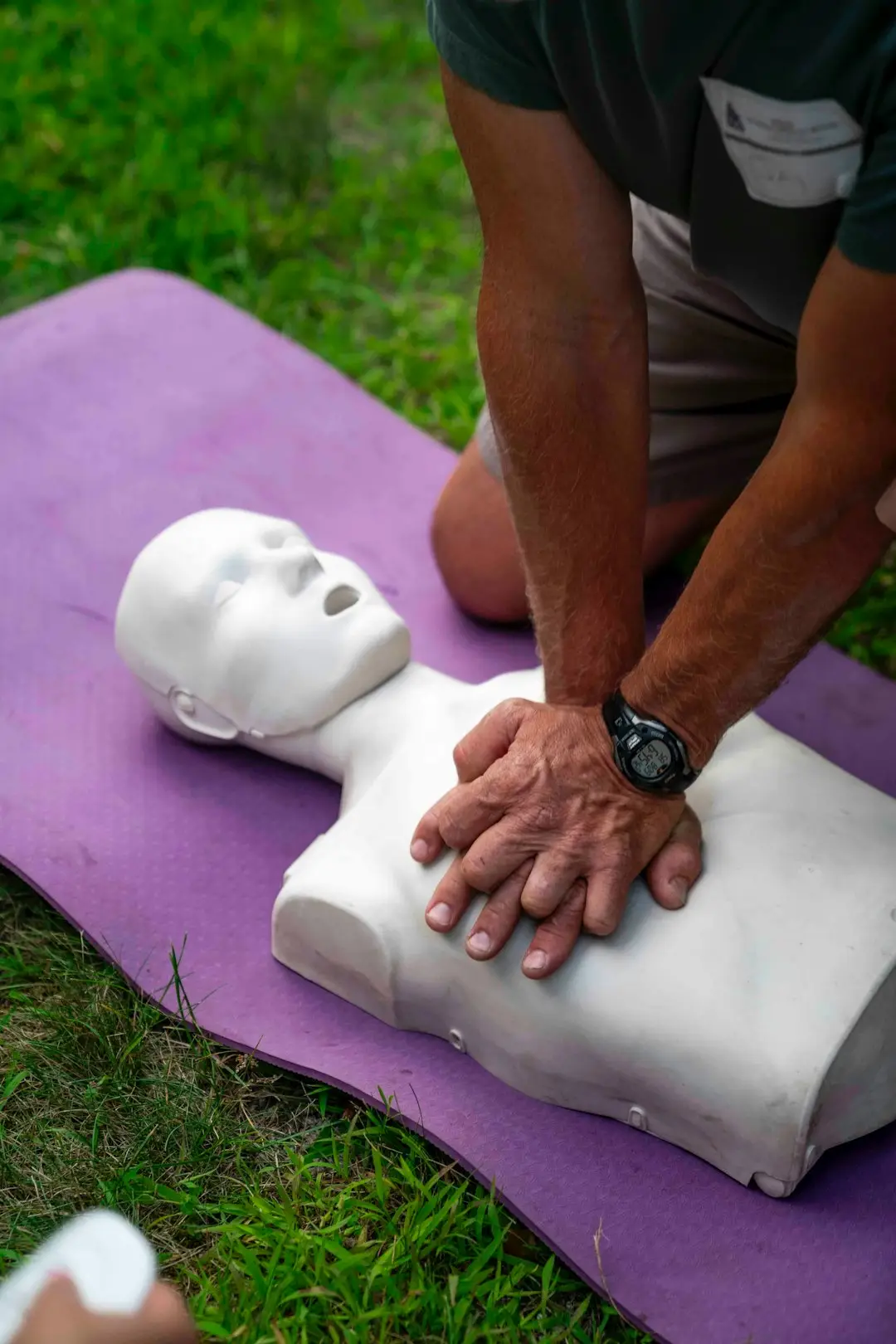
For a teen or adult who suddenly collapses outside a hospital, the AHA teaches two steps [4]. First, call 911, or send someone to do it. Second, push hard and fast in the center of the chest.
“Hard and fast” has real numbers behind it. For an average adult, the AHA’s CPR guidance is 100 to 120 pushes a minute, at least 2 inches deep, while avoiding going deeper than about 2.4 inches [4]. That is quicker than most people expect. Keep going until emergency crews arrive [3].
The AHA says immediate CPR can double or triple a person’s chance of survival [4]. It also says hands-only CPR can be as effective as CPR with breaths [3]. So if you feel unsure about giving breaths, you can still help.
You will not be alone, either. When you call 911, try to stay calm, know your location, and do not hang up. The dispatcher may coach you through hands-only CPR. The AHA also notes that people who call do not have to give their name or phone number. If two people are there, one can start CPR right away while the other calls 911 and finds an AED [3].
Children and babies are different. The AHA notes that for children, breathing problems are the most common cause of cardiac arrest, and the steps change [3]. A CPR class is the best place to learn child and infant CPR.
Use an AED if one is nearby
An AED, or automated external defibrillator, is a portable device that sends an electric shock to the heart to try to bring back a normal rhythm [2]. You may find them in places like offices, schools, and gyms [2]. The AHA says AEDs can greatly increase a person’s chance of survival. It also says AED use should not be limited to trained people, although training is still recommended [4]. If someone brings an AED, use it as soon as it arrives [3].
Many people worry they will “do it wrong.” That worry is normal. But in cardiac arrest, doing nothing is the bigger risk. Trying to help is what counts.
Tru-Tips: Save your home and work addresses in your phone’s notes. In a scary moment, it can be hard to remember details. Having them ready makes it easier to tell the 911 dispatcher exactly where you are.
Get ready this month
Being ready does not take long. A few small actions now can help you feel calmer if you ever face an emergency. Here are some questions to ask yourself this month:
- Where is the AED at my job, gym, school, apartment building, or senior center?
- Does anyone in my home know hands-only CPR?
- Is there a CPR class near me? Ask your local fire department, hospital, or library.
- If I have a heart condition, what should my family know? Ask your care team.
NHLBI notes that AED training is often offered alongside CPR classes [2]. If you have a heart condition, your care team can explain your own risks and what your family should know. You can say: “If something happened to me at home, what would you want my family to do?”
Let’s talk about it
Have you ever taken a CPR class, or noticed an AED somewhere you go often? What would help you feel more ready to step in during an emergency?
One Tru Step: This week, find the AED at one place you go often, and watch a short hands-only CPR video with someone you live with.
Sources and further reading
- Heart Rhythm Society: Sudden Cardiac Arrest Awareness Month
- National Heart, Lung, and Blood Institute: Cardiac Arrest
- American Heart Association: Heart Attack or Sudden Cardiac Arrest? How Are They Different?
- American Heart Association: What Is CPR?
Sources checked October 15, 2026. General education; individual care and coverage questions require an appropriate professional.
Related Health Hubs
Join the conversation 💬
This is your space. Share a tip that helped you, ask the question you have been wondering about, or cheer on someone going through the same thing. Your comment shows up right away, and no account is needed.
Our house rules (they keep this a feel-good spot): Be kind. Stay on topic. Keep it free of religion, politics, and anything hurtful. Comments that break these rules are removed.
Protect your privacy: Use a first name or nickname, and skip full names, phone numbers, and personal health details.
If you or someone you know is in crisis, call or text 988. In an emergency, call 911.