


If you or someone near you has sudden signs of a stroke, call 911 immediately. Do not finish reading a blog, search for an appointment, or wait to see whether the problem gets better. CDC explains that emergency treatment can begin with the ambulance team. [2]
✔ Backed by: Centers for Disease Control and Prevention (CDC) · National Institute of Neurological Disorders and Stroke (NIH). Each fact links to its source, and the full list is at the bottom of this post.
Picture this. It is a slow Sunday afternoon. Your partner is telling a story at the kitchen table, and suddenly the words come out jumbled. They laugh it off: “I’m just tired.” A minute later they seem almost fine. Would you know these stroke warning signs and what to do?
Most of us would hesitate. We don’t want to overreact, call an ambulance “for nothing,” or embarrass anyone. That pause is very human. But with stroke, it is the one feeling worth pushing past. Let’s talk about why, and how to get ready now, while there is time to talk.
Stroke warning signs: what a stroke can look like
Stroke warning signs include sudden trouble walking or balancing and changes in vision. Others are numbness or weakness, especially on one side, and confusion or difficulty speaking or understanding. A severe headache without a known cause is another sign. Call 911 if these symptoms appear. You do not have to be certain it is a stroke before seeking emergency help. [1]
The key word is sudden. Something that was normal a minute ago is suddenly not. You don’t need to figure out what is wrong. That is the emergency team’s job. Your job is to notice and make the call.
Have you ever watched someone you love brush off a symptom because they didn’t want a fuss? Many of us have. It helps to decide ahead of time that sudden signs mean 911, no debate.
Remember B.E. F.A.S.T.
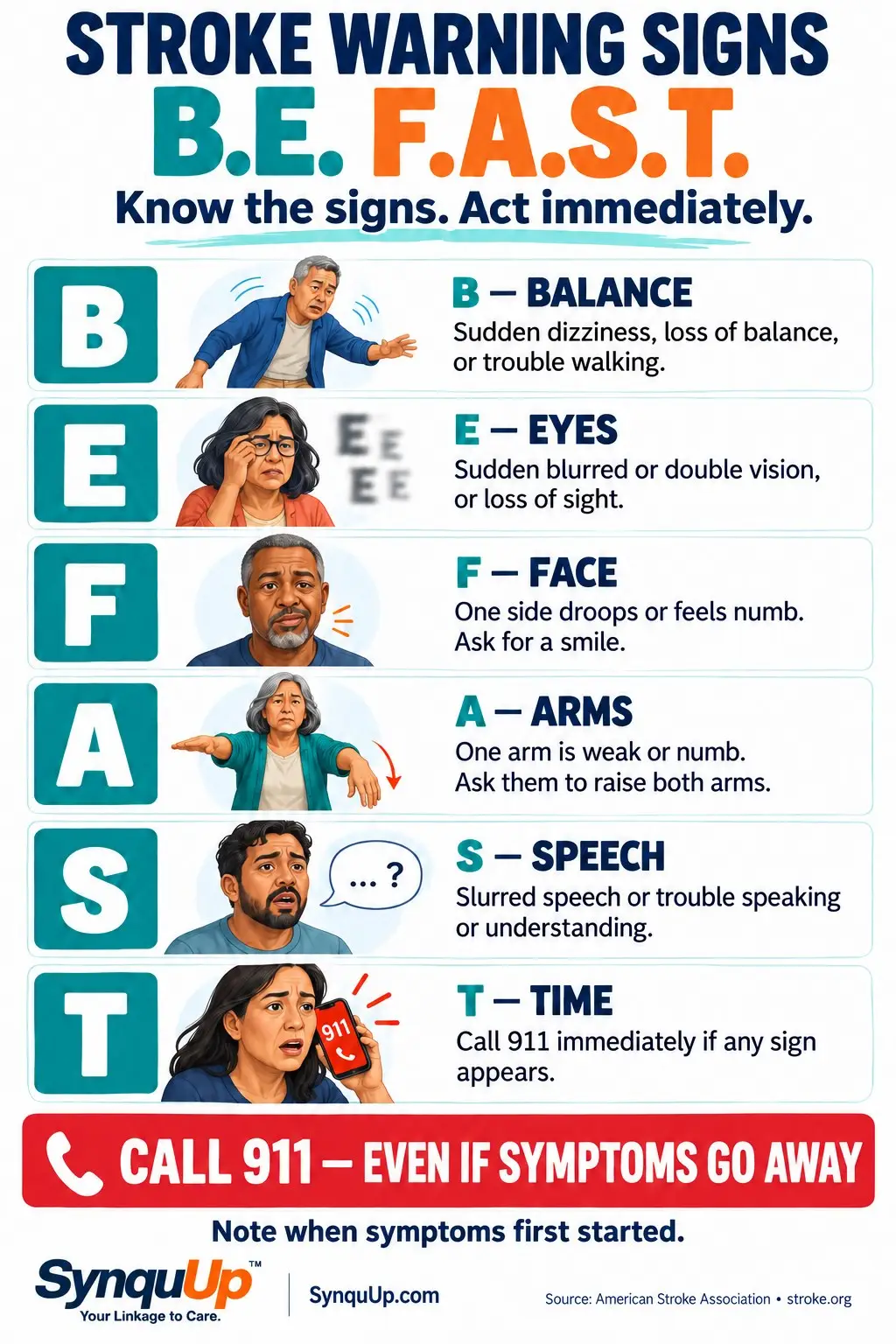
- B—Balance: Sudden loss of balance or coordination.
- E—Eyes: Sudden changes in vision.
- F—Face: One side may droop.
- A—Arms: One arm may be weak or drift down.
- S—Speech: Speech may be slurred or unusual.
- T—Time: Call 911 right away.
This reminder supports recognition; it does not rule out a stroke when every sign is absent. CDC’s full list of sudden symptoms also matters. [1] One easy way to make it stick is to say the letters out loud with your family once. Try it at dinner or on a car ride. It may feel a little silly. That’s okay. Silly is easy to remember.
“But it went away.” Why you still call
This is one of the hardest moments. The face looks normal again. The arm feels strong. Everyone breathes a sigh of relief and wants to move on. Please don’t.
Brief symptoms may be a transient ischemic attack, or TIA, and still need immediate medical attention. CDC advises calling an ambulance rather than driving so emergency care can begin on the way. Note when symptoms started, if you know, and tell responders. [1] The National Institute of Neurological Disorders and Stroke (NINDS) explains that a TIA is brief. Even so, it is a sign of a serious condition that will not go away without medical help. [4]
Imagine a talk like this:
You: “I’m calling 911.”
Your dad: “Don’t. I’m fine now. It passed.”
You: “I’m so glad it passed. But even signs that go away need to be checked right away. I’d rather they look and it’s nothing than wait and be sorry.”
Notice that you don’t argue about whether it was a stroke. You just hold the line kindly.
Why every minute matters
Stroke is more common than many people realize. CDC reports that someone in the United States has a stroke every 40 seconds. It also reports that stroke is a leading cause of serious long-term disability. The same CDC page also shares some hope: stroke is preventable and treatable. [3]
Treatment depends on time. NINDS explains that the best treatments for the most common type of stroke have a time limit. Doctors can only use them within a limited window of hours after the first symptoms. [4] That is why making the call matters more than being sure. Let the emergency team figure out what is happening.
What to do while help is on the way
When you call, keep it simple. You might say: “I think my husband is having a stroke. His speech is slurred and one side of his face is drooping. It started about ten minutes ago.” Then give your address and follow the dispatcher’s directions.
Once you have called 911, stay with the person if you can. Look at a clock and note when the symptoms first started. NINDS says this time helps doctors choose treatment. [4] If you do not know the exact time, simply tell responders what you do know.
Do not drive the person to the hospital, and do not let them drive themselves. NINDS advises calling an ambulance so medical personnel can start treatment on the way. [4] While you wait, you might unlock the front door, turn on a porch light, or ask someone to watch for the ambulance. A medication list can go along too, but only if it is already close by.
Two surprises: waking up with signs, and younger people
Stroke warning signs do not always begin while a person is awake. NINDS notes that anyone who suspects a stroke should get to the hospital as soon as possible. That includes someone who wakes up with symptoms, because some people can still benefit from treatment later on. [4] Waking up with a drooping face, a weak arm, or trouble speaking is not something to sleep off. Call 911.
Many people also think, “I’m too young for a stroke.” Stroke risk goes up with age, but CDC is clear that strokes can happen at any age. In CDC’s data, a large share of people hospitalized for stroke were younger than 65. [3] A young adult, a busy parent, or a coworker who seems perfectly healthy can have a stroke. When the signs are sudden, the rule is the same for everyone: call 911.
When someone insists they are fine
A person having a stroke may insist they are fine. They may feel embarrassed, or the stroke itself may cause confusion and trouble understanding what is going on. [1] It is okay to make the call anyway. You are not overreacting by asking trained responders to check.
It can help to agree on this ahead of time, while everyone is calm. You might say: “If I ever see stroke signs in you, I’m going to call 911, even if you tell me not to. Will you do the same for me?” What would it take for your family to make that promise to each other?
A kitchen-table plan
Ask the people you live with or regularly see whether they know the emergency number and your address. Talk about where you keep a current medication list and emergency contacts. These details are useful preparation, but gathering papers should never delay the call.
If you live alone, think about how you would reach emergency services from the rooms where you spend time. Keep your phone within reach. Ask a trusted person to talk through the plan with you while there is no emergency. Living alone can make this feel scary to think about. A plan turns some of that worry into something you can act on.
Prevention starts at your regular visit
At a regular appointment, ask your clinician which health issues you should address and what follow-up is right for you. That conversation belongs in routine care. New sudden symptoms belong with emergency services.
CDC names high blood pressure, high cholesterol, smoking, obesity, and diabetes as leading causes of stroke. About one in three U.S. adults has at least one of them. CDC also reports that nearly one in four strokes happen in people who have had a stroke before. [3] You might ask: “Which of these apply to me, and what next steps make sense for my health?” If you have already had a stroke or TIA, keeping up with follow-up care is part of protecting your future.
Let’s talk
Now it’s your turn. We would love to hear from you in the comments below.
Has your family ever talked about what to do if someone shows stroke signs? What made that talk easier?
What would make it hard for you to call 911 for someone who says they’re fine? What could help you push past that?
If you live alone, what is one thing in your plan that helps you feel more ready?
One Tru Step: Share the B.E. F.A.S.T. reminder with one person today and agree that sudden stroke signs mean calling 911.
Sources and further reading
- CDC: Signs and Symptoms of Stroke
- CDC: Treatment and Intervention for Stroke
- CDC: Stroke Facts
- NINDS: Stroke Signs and Symptoms
Sources checked October 10, 2026. General education; individual care and coverage questions require an appropriate professional.
Related Health Hubs
Join the conversation 💬
This is your space. Share a tip that helped you, ask the question you have been wondering about, or cheer on someone going through the same thing. Your comment shows up right away, and no account is needed.
Our house rules (they keep this a feel-good spot): Be kind. Stay on topic. Keep it free of religion, politics, and anything hurtful. Comments that break these rules are removed.
Protect your privacy: Use a first name or nickname, and skip full names, phone numbers, and personal health details.
If you or someone you know is in crisis, call or text 988. In an emergency, call 911.