

✔ Backed by: Centers for Disease Control and Prevention (CDC) · MedlinePlus (National Library of Medicine) · American Academy of Ophthalmology · National Institutes of Health (NIH) · HealthCare.gov. Each fact links to its source, and the full list is at the bottom of this post.
Picture this. Your seven-year-old is doing homework at the kitchen table. You notice they are leaning so close to the page that their nose almost touches it. Later, during a movie, they scoot right up to the TV. You think, Is that just a kid thing, or should I be worried? It is a fair children’s eye health question.
That small question matters. Kids often do not know they see poorly. They think everyone sees the way they do. And problems like lazy eye (amblyopia) and crossed eyes (strabismus) are easier to treat when they are found early [1]. So let’s talk about children’s eye health, like two friends at the kitchen table.
“My child would tell me if something was wrong.” Would they?
It is natural to think a child would speak up if things looked blurry. But think about it from their side. If the board at school has always looked fuzzy, how would they know it is supposed to look sharp? To them, that is just how the world looks.
So we watch for clues instead. Parents often notice things like squinting, tilting the head, or covering one eye. Some kids sit very close to the TV, hold books close, rub their eyes a lot, or complain of headaches. Others have eyes that seem to turn in or out, or trouble reading or paying attention in class. None of these means something is wrong for sure. But any of them is a good reason to ask. Have you ever brushed off a clue like this, thinking it was just a phase?
Here is a quick look at the words you might hear. A refractive error means the eye does not focus light the right way, which causes blurry vision. Nearsightedness, farsightedness, and astigmatism are all refractive errors. Lazy eye means vision in one eye is weaker because the brain leans on the stronger eye. Crossed eyes means the eyes do not point at the same thing at the same time [1].
“But they passed the school screening”
This one trips up a lot of families. Vision is checked at well-child visits, and many schools also screen [2]. That is great. But a screening is not the same as a full eye exam [2]. It is a quick check, not a deep look.
If a screening flags a problem, or you keep noticing those clues at home, ask for a visit with an eye doctor. If a problem is found at a checkup, the child’s doctor may send you to an eye doctor for a full exam [1]. Your gut counts too. You see your child every day.
What to say at the visit
Checkups can move fast, and eyes can get skipped in the rush. A few simple lines help.
You: “Did my child pass the vision screening? What were the results?”
Then: “I’ve noticed some squinting at home. Do you think my child needs a full exam with an eye doctor?”
And if glasses come up: “How often should we come back to check them?”
It helps to write down what you notice, with dates, and bring the list to the visit. You can also ask your child’s teacher whether they see squinting or trouble seeing the board. Teachers notice a lot.
Talking with your child about glasses
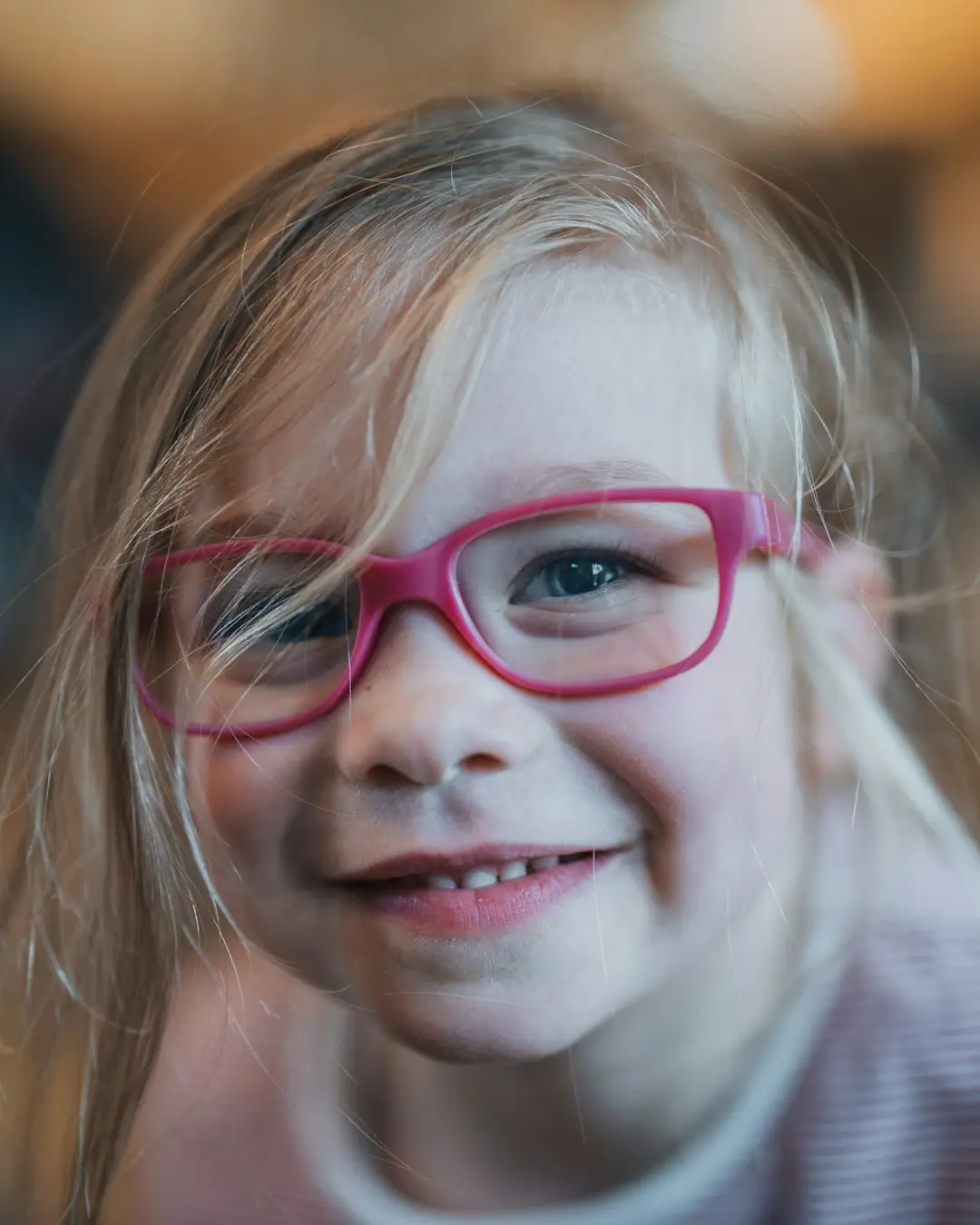
Sometimes the hard part is not the exam. It is the feelings. Some kids worry glasses will make them look different or get them teased. That worry is real, and it helps to name it.
Your child: “I don’t want glasses. Everyone will laugh.”
You: “I hear you. That would feel awful. But glasses help your eyes and your brain work together, so reading and games get easier. Want to pick out frames you really like?”
Letting a child have a say, like choosing the color, can turn “I have to” into “I get to.” What has helped a child in your life feel proud of their glasses?
Keeping eyes safe at home and at play
Many children’s eye injuries happen at home and during sports [3]. At home, a little planning goes a long way. Keep fireworks, BB guns, and laser pointers away from children. Store cleaners and sprays out of reach. For young kids, choose toys without sharp or flying parts.
Sports are where many parents get surprised. Most sports-related eye injuries can be prevented with the right eyewear [4]. Higher-risk sports include baseball, softball, basketball, hockey, paintball, and racquet sports [4]. And here is a big one: regular glasses or sunglasses do not protect eyes during sports. Kids need protective eyewear made of polycarbonate, a very strong plastic, and it can be made with a prescription [4].
Not every team asks for eye protection, so check for yourself. Wear it at practice, not just at games. If you are not sure what to buy, ask an eye doctor or coach. You might say to a coach, “Does the team recommend eye protection? What do other families use?”
Everyday habits for children’s eye health
Screens are part of life now, and that is okay. Still, it helps to limit screen time and take frequent breaks. More screen time can make vision problems that have not been corrected worse [1]. Getting outside helps too, because looking at faraway things gives eyes a rest from close-up work [1]. On sunny days, use sunglasses with 100% UV protection [1]. Fruits, vegetables, and good sleep help the whole body. Which of these would be easiest to try in your home this week?
When it is an emergency, act fast
Eye injuries can be scary, and it is easy to freeze. Get care right away for any of these [3]:
- A chemical splash in the eye
- An object stuck in the eye
- A cut on the eye or eyelid
- A sudden change in vision
For chemicals, rinse the eye with clean water for several minutes and then get help. Do not rub the eye or try to remove a stuck object [3]. Make sure grandparents and sitters know this plan too.
When cost is the worry
Cost should not stop you from getting your child’s eyes checked, and help is out there. All plans in the Health Insurance Marketplace include vision coverage for children [5]. CHIP covers dental and vision care, and well-child visits are free. Benefits vary by state. You can apply any time of year by calling 1-800-318-2596 or at HealthCare.gov [6].
If you have a job-based plan, call the number on your card and ask, “Does my plan cover eye exams and glasses for my child?” Keep a copy of eye exam results and glasses prescriptions with your child’s health papers so they are easy to find.
Let’s talk
Now it’s your turn. We would love to hear from you in the comments below.
What was the first clue that made you wonder about a child’s vision?
How did you help a child feel okay about wearing glasses or sports goggles? What words worked?
Does your child’s team talk about eye protection? What would make it easier to bring up with a coach?
One Tru Step: At your child’s next checkup, ask, “Is my child’s vision on track, and do they need a full eye exam?”
Sources and further reading
- CDC: Keep an Eye on Your Child’s Vision
- MedlinePlus: Vision Screening
- American Academy of Ophthalmology: Children’s Eye Injuries: Prevention and Care
- National Eye Institute: Sports and Eye Safety Tips for Parents and Teachers
- HealthCare.gov: What Marketplace Health Insurance Plans Cover
- HealthCare.gov: Children’s Health Insurance Program (CHIP)
Sources checked October 10, 2026. General education; individual care and coverage questions require an appropriate professional.
Related Health Hubs
Join the conversation 💬
This is your space. Share a tip that helped you, ask the question you have been wondering about, or cheer on someone going through the same thing. Your comment shows up right away, and no account is needed.
Our house rules (they keep this a feel-good spot): Be kind. Stay on topic. Keep it free of religion, politics, and anything hurtful. Comments that break these rules are removed.
Protect your privacy: Use a first name or nickname, and skip full names, phone numbers, and personal health details.
If you or someone you know is in crisis, call or text 988. In an emergency, call 911.