

✔ Backed by: American Heart Association · Centers for Disease Control and Prevention (CDC) · American Medical Association. Each fact links to its source, and the full list is at the bottom of this post.
Call 911 if your blood pressure is higher than 180/120 and you have chest pain, shortness of breath, back pain, numbness, weakness, a change in vision, or trouble speaking [1]. Do not wait to see if it gets better.
High blood pressure usually has no warning signs, and many people do not know they have it. Measuring, at a clinic or by checking blood pressure at home, is the only way to know [2]. You can feel perfectly fine while it quietly strains your blood vessels. Over time, the CDC explains, high blood pressure can lead to heart disease and stroke [2].
It helps to know what the numbers mean. The CDC says normal blood pressure is below 120/80, and high blood pressure is consistently at or above 130/80 [2]. Your own goal may be different, so ask your care team what range is right for you.
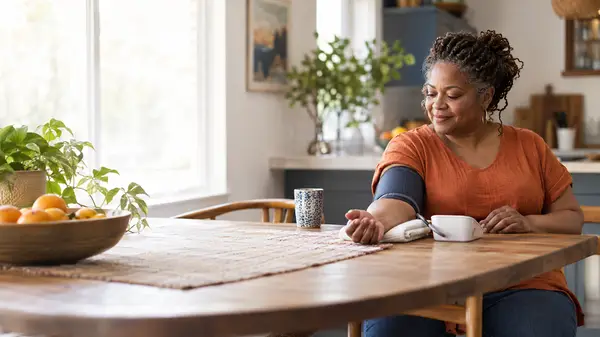
Checking blood pressure at home can give you and your care team a fuller picture. A reading at the clinic is just one moment in time. Readings from home show what your numbers look like on ordinary days. The American Heart Association recommends home monitoring for all people with high blood pressure. This helps clinicians see whether treatment is working [1]. But home numbers only help if they are measured the right way. Here is how.
Checking blood pressure at home starts with a monitor you can trust
The AHA recommends an automatic, cuff-style monitor that goes on your upper arm. It says wrist and finger monitors are not recommended [1]. Look for a monitor that has been validated, which means it was tested for accuracy. The American Medical Association supports a free list of validated devices at validatebp.org. An independent committee of blood pressure experts reviews the devices [3].
Cuff size matters, too. A cuff that does not fit can give wrong readings. The AHA suggests measuring around your upper arm and choosing a monitor that comes with the right cuff size [1]. If you are an older adult or pregnant, check that the monitor is validated for you [1]. A pharmacist can help you compare options and check the fit. You can say: “Can you help me find a validated upper-arm monitor with the right cuff size for me?”
Not ready to buy one yet? The CDC notes that some pharmacies have a digital blood pressure machine. You can get your blood pressure checked there. Need help? A member of your health care team can also show you how to use a home monitor [4].
Get ready before checking blood pressure at home
Small things can push your numbers up for a short time. A cup of coffee, a cigarette, a brisk walk, or even a full bladder can change a reading. That is why the AHA suggests not smoking, drinking caffeine, or exercising for 30 minutes before you measure. It also suggests emptying your bladder first [1]. The CDC also suggests not eating or drinking anything for 30 minutes before a reading [4].
Next, rest quietly for at least five minutes, without talking or using your phone [1]. The CDC suggests sitting in a comfortable chair with your back supported, both feet flat on the floor, and your legs uncrossed [4]. For example, imagine you sit down right after rushing up the stairs while chatting on the phone. Your reading may come out higher than your usual number. A few calm minutes can make the result more useful.
Measure the same way each time
Doing things the same way each time makes it easier to compare your numbers from day to day. Here is a short checklist based on AHA guidance [1]:
- Rest your arm on a flat surface at heart level. A pillow can help.
- Put the cuff on bare skin, just above the bend of your elbow, not over clothing.
- Measure at the same time each day.
- Take two readings, one minute apart, and write both down.
Writing down both numbers matters. One reading can be a little off, and two give a truer picture. The AHA offers a printable tracker, and some monitors store your readings for you [1]. A notebook works just as well. Use whatever is easiest for you to keep up with. You can use either arm, since readings usually differ little between them [1]. Many people pick one arm and stick with it.
Tru-Tips: Keep your monitor, a pen, and your log in the same spot, such as next to the chair where you measure. When everything is ready and in sight, it is much easier to make checking a habit.
What to do with a high reading
One high number is not always an emergency. The AHA says to take it again, write down both results, and check with your clinician [1]. If a reading is suddenly above 180/120, wait at least one minute and test again. If it is still very high, contact your health care professional right away [1]. If you have any of the warning signs listed at the top of this article, call 911.
It can help to ask your care team ahead of time what you should do with high or low readings. That way, you have a plan before you need one, and you are not left guessing.
Bring your monitor and your numbers to your visit
Take your monitor to your next appointment. Ask your care team to check that you are using it the right way. They can also check that its readings match their equipment. The AHA suggests bringing it in once a year, or as the company directs. If your monitor stores readings, bring it along [1].
This visit is also a great time to ask questions. You can say: “What range should my numbers be in?” You might also ask, “How often should I check, and for how long?” and “Which readings mean I should call you?” If you keep a paper log, ask, “How would you like me to send you my numbers?” The CDC also encourages talking with your health care team about how often to measure [4].
Please do not change or stop any medicine based on a home reading alone. The AHA advises talking with your clinician first [1].
Let’s talk about it
Do you check your blood pressure at home? What helps you remember, or what makes it hard to keep up with?
One Tru Step: Pick one time of day for your checks, such as before breakfast, and set a daily phone reminder for that time.
Sources and further reading
- American Heart Association. Monitoring Your Blood Pressure at Home.
- Centers for Disease Control and Prevention. About High Blood Pressure.
- American Medical Association. Validated Device Listing (validatebp.org).
- Centers for Disease Control and Prevention. Measuring Your Blood Pressure.
Sources checked October 15, 2026. General education; individual care and coverage questions require an appropriate professional.
Related Health Hubs
Join the conversation 💬
This is your space. Share a tip that helped you, ask the question you have been wondering about, or cheer on someone going through the same thing. Your comment shows up right away, and no account is needed.
Our house rules (they keep this a feel-good spot): Be kind. Stay on topic. Keep it free of religion, politics, and anything hurtful. Comments that break these rules are removed.
Protect your privacy: Use a first name or nickname, and skip full names, phone numbers, and personal health details.
If you or someone you know is in crisis, call or text 988. In an emergency, call 911.